![[:de]fsk Kino Logo[:]](https://fsk-kino.peripherfilm.de/wp-content/uploads/2022/08/kino-fsk-logo-dark.png)
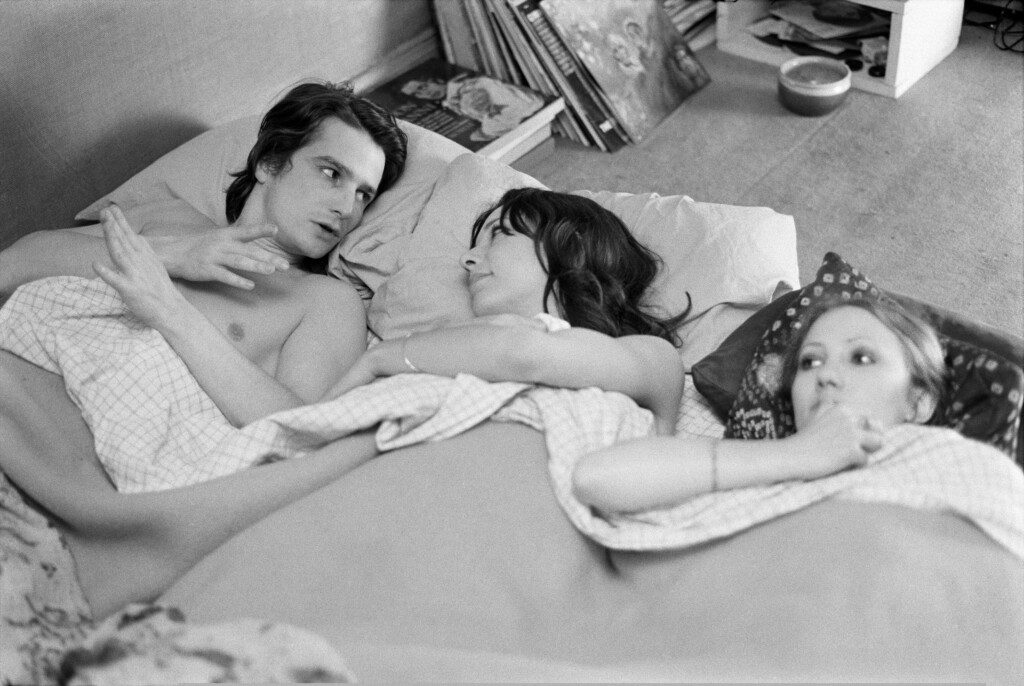
Jean Eustache, a trained electrician and self-taught filmmaker, was, as the son of a working-class family, an exceptional figure within the otherwise bourgeois Nouvelle Vague. His life is reflected in his films in an almost autobiographical way. With a precise attention to language, gestures and social realities, Eustache’s cinema operates within the realm of documentary fiction. Thanks to the Re:Visted series from Grand film distributors, we are able to offer two of his classics:
LA MAMAN ET LA PUTAIN from 1973, in which Jean-Pierre Léaud plays Alexandre, a flâneur caught between two women and endless conversations in Parisian cafés as he searches for his true self. [Tickets]
In the autobiographically inspired 1974 film MES PETITES AMOUREUSES, 13-year-old Daniel is torn from his sheltered country life and thrust into the confines of the city and the harshness of the adult world. [Tickets]
LA ROSIÈRE DE PESSAC (1968) & LA ROSIÈRE DE PESSAC 79 (1979)
Two documentary films about the election and the festival of the Rose Queen in Pessac, near Bordeaux, which take place annually in April and June. The compilation does not take an explicit stance on the events; its straightforward documentation, in 1968 and eleven years later, highlights the changes that have taken place. Sun., 5.9. [Tickets]
UNE SALE HISTOIRE (1977) consists of two films: First came a 16mm film, shot in the style of cinéma vérité, in which a man recounts his voyeuristic experiences in the toilet of a Parisian café, where he discovered a hole in the wall leading to the ladies’ toilet. Eustache later had his text, shot on 35mm, narrated by a professional actor. However, the films are screened in reverse order, with the fiction coming before the documentary – which naturally raises the question of what is real and what is not in the story told by Picq. In this way, Eustache achieved a unique reflection on the relationship between the documentary and the fictional. [Tickets]
NUMÉRO ZÉRO (1971) – the title refers to a kind of starting point, and indeed, Eustache has, in cinematic terms, started from scratch here: he has his grandmother, Odette Robert, recount her life, interrupted only by brief questions or comments from Eustache to keep the conversation flowing. [Tickets]
DU CÔTÉ DE ROBINSON (1964) Two young men go out looking for women one Sunday afternoon in Montmartre. The film focuses on everyday occurrences that were not normally depicted in the cinema of that era. &
LE PÈRE NOËL A LES YEUX BLEUS (1966) To raise the money for a coat, a young man takes a job as a department-store Father Christmas. Once again, Eustache blends observations of everyday life with fiction, thereby painting a melancholic portrait of a provincial town. [Tickets]
Translated with DeepL.com (free version)