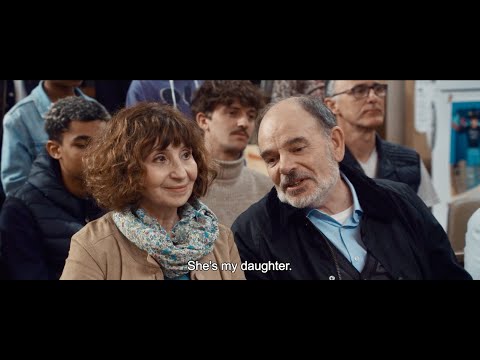
Isabell’s life takes a turn when she realises that her elderly parents can no longer live independently. The search for carers is difficult and there are also complications in her marriage to Philippe. She shuttles between Berlin and her parents’ weekend house, a striking modernist building designed by her prominent father himself in better days. There, Isabell repeatedly encounters the enigmatic Anja, a single mother who is struggling to make ends meet. An unexpected bond begins to form. The more Anja and her daughter Greta become part of Isabell’s life, the more uncertain she feels about the existence she has so carefully built for herself. Isabell senses the ground shifting beneath her feet as she increasingly loses control.
Credits:
DE/FR 2024, 100 Min., Regie: Ina Weisse Kamera:Judith Kaufmann Schnitt: Hansjörg Weißbrich mit Nina Hoss, Saskia Rosendahl, Vincent Macaigne, Thorsten Merten
Isabell’s life takes a turn when she realises that her elderly parents can no longer live independently. The search for carers is difficult and there are also complications in her marriage to Philippe. She shuttles between Berlin and her parents’ weekend house, a striking modernist building designed by her prominent father himself in better days. There, Isabell repeatedly encounters the enigmatic Anja, a single mother who is struggling to make ends meet. An unexpected bond begins to form. The more Anja and her daughter Greta become part of Isabell’s life, the more uncertain she feels about the existence she has so carefully built for herself. Isabell senses the ground shifting beneath her feet as she increasingly loses control.
Credits:
DE/FR 2024, 100 Min., Regie: Ina Weisse Kamera:Judith Kaufmann Schnitt: Hansjörg Weißbrich mit Nina Hoss, Saskia Rosendahl, Vincent Macaigne, Thorsten Merten
»Why haven’t I seen this before?« In the first scene of Copa 71, American international footballer Brandi Chastain stares at her tablet in amazement. She is watching footage of the first ever international women’s football tournament in Mexico City in 1971, Copa 71. Why is it that one of the best-attended women’s sporting events of all time has been forgotten?
In 1970, the first European tournament took place in Italy; SC 07 Bad Neuenahr represented Germany. A year later, international teams from Argentina, England, France, Denmark and Mexico competed against each other in Mexico. This purely commercial event, which was not backed by FIFA, proved a huge success, attracting crowds of 100,000 to the stadiums. Yet what could have been the launch pad for women’s football worldwide failed to attract any support. Another ten years would pass before the next international tournament. In Taipei, Taiwan, SSG 09 Bergisch Gladbach became world champions in 1981. This also paved the way for the formation of an official women’s national team in Germany in 1982. One thing to note though: women’s football was officially banned until 1970. Perhaps not surprising then that another decade passed before the first FIFA Women’s World Cup was held, in China. The final saw Brandi Chastain score the winning penalty to help the US take the trophy home.
The film presents archive footage of the tournament, plus interviews with the players of the time – impressive personalities who provide vivid accounts of the preparations and the tournament itself. A threatened walk-out by the Mexican team over pay at one point put the tournament in jeopardy, as did the tense atmosphere between the teams, still tangible when watching the film in the cinema.
Credits:
GB 2023, 91 Min., Englisch/Spanisch/Italienisch/Französisch mit deutschen Untertiteln, Regie: Rachel Ramsay und James Erskine Schnitt: Arturo Calvete und Mark Roberts Kamera: Angela Neil
The film follows Amber Kumar Gurung and Guna Raj Kuikel, two Bhutanese bureaucrats, in their travels through the small Himalayan kingdom as census workers, measuring people’s happiness levels. They work for the Center for Gross National Happiness, a government institution which is tasked with collecting data on the citizens‘ happiness. This data is then used to inform the constitutionally-mandated goal of increasing national happiness.[5]
Along the way we meet Bhutan’s everyday people, such as a transgender bar singer, a wealthy farmer and his three wives, a teenage girl who worries about her mother’s alcoholism, or a recent widower who finds solace in religion. Through them we get a glimpse into the Bhutanese society and their views on happiness in face of adversity. We also explore Amber’s dreams and ambitions, primarily among them the dream of finding love.
Aya is a woman in her early thirties. After astonishing everyone by saying “No” on her wedding day, she leaves the Ivory Coast for a new life in China. Living in an area where the African diaspora meets the Chinese culture, she finds a job in a tea boutique owned by Cai, a 45-year-old Chinese man. In the privacy of the shop’s backroom, Cai initiates Aya into the Chinese tea ceremony. As he teaches her this ancient art, their relationship slowly grows into one of tender love. But for their burgeoning passion to be supported by trust, both of them must let go of their burdens and face up to their pasts.
Credits:
FR/MR/LU/TW/CI 2024, 111 Min., Mandarin, Französisch, Englisch, Portugiesisch OmU Regie: Abderrahmane Sissako Kamera:Aymerick Pilarski Schnitt: Nadia Ben Rachid mit Nina Mélo, Chang Han, Wu Ke-Xi, Michael Chang
An expansive and revelatory inside look at John Lennon and Yoko Ono’s life in Greenwich Village in the early 1970s, ONETOONE: JOHN&YOKO delivers an immersive cinematic experience that brings to life electrifying, never-before-seen material and newly restored footage of John and Yoko’s only full-length concert. Featuring mind-blowing music newly remixed and produced by Sean Ono Lennon, the film is a seismic revelation that will challenge pre-existing notions of the iconic couple.
Credits:
UK 2024, 100 Min., engl. OmU Regie: Kevin Macdonald Kamera: David Katznelson Schnitt: Sam Rice-Edwards
»Why haven’t I seen this before?« In the first scene of Copa 71, American international footballer Brandi Chastain stares at her tablet in amazement. She is watching footage of the first ever international women’s football tournament in Mexico City in 1971, Copa 71. Why is it that one of the best-attended women’s sporting events of all time has been forgotten?
In 1970, the first European tournament took place in Italy; SC 07 Bad Neuenahr represented Germany. A year later, international teams from Argentina, England, France, Denmark and Mexico competed against each other in Mexico. This purely commercial event, which was not backed by FIFA, proved a huge success, attracting crowds of 100,000 to the stadiums. Yet what could have been the launch pad for women’s football worldwide failed to attract any support. Another ten years would pass before the next international tournament. In Taipei, Taiwan, SSG 09 Bergisch Gladbach became world champions in 1981. This also paved the way for the formation of an official women’s national team in Germany in 1982. One thing to note though: women’s football was officially banned until 1970. Perhaps not surprising then that another decade passed before the first FIFA Women’s World Cup was held, in China. The final saw Brandi Chastain score the winning penalty to help the US take the trophy home.
The film presents archive footage of the tournament, plus interviews with the players of the time – impressive personalities who provide vivid accounts of the preparations and the tournament itself. A threatened walk-out by the Mexican team over pay at one point put the tournament in jeopardy, as did the tense atmosphere between the teams, still tangible when watching the film in the cinema.
Credits:
GB 2023, 91 Min., Englisch/Spanisch/Italienisch/Französisch mit deutschen Untertiteln, Regie: Rachel Ramsay und James Erskine Schnitt: Arturo Calvete und Mark Roberts Kamera: Angela Neil
The film follows Amber Kumar Gurung and Guna Raj Kuikel, two Bhutanese bureaucrats, in their travels through the small Himalayan kingdom as census workers, measuring people’s happiness levels. They work for the Center for Gross National Happiness, a government institution which is tasked with collecting data on the citizens‘ happiness. This data is then used to inform the constitutionally-mandated goal of increasing national happiness.[5]
Along the way we meet Bhutan’s everyday people, such as a transgender bar singer, a wealthy farmer and his three wives, a teenage girl who worries about her mother’s alcoholism, or a recent widower who finds solace in religion. Through them we get a glimpse into the Bhutanese society and their views on happiness in face of adversity. We also explore Amber’s dreams and ambitions, primarily among them the dream of finding love.
Aya is a woman in her early thirties. After astonishing everyone by saying “No” on her wedding day, she leaves the Ivory Coast for a new life in China. Living in an area where the African diaspora meets the Chinese culture, she finds a job in a tea boutique owned by Cai, a 45-year-old Chinese man. In the privacy of the shop’s backroom, Cai initiates Aya into the Chinese tea ceremony. As he teaches her this ancient art, their relationship slowly grows into one of tender love. But for their burgeoning passion to be supported by trust, both of them must let go of their burdens and face up to their pasts.
Credits:
FR/MR/LU/TW/CI 2024, 111 Min., Mandarin, Französisch, Englisch, Portugiesisch OmU Regie: Abderrahmane Sissako Kamera:Aymerick Pilarski Schnitt: Nadia Ben Rachid mit Nina Mélo, Chang Han, Wu Ke-Xi, Michael Chang
An expansive and revelatory inside look at John Lennon and Yoko Ono’s life in Greenwich Village in the early 1970s, ONETOONE: JOHN&YOKO delivers an immersive cinematic experience that brings to life electrifying, never-before-seen material and newly restored footage of John and Yoko’s only full-length concert. Featuring mind-blowing music newly remixed and produced by Sean Ono Lennon, the film is a seismic revelation that will challenge pre-existing notions of the iconic couple.
Credits:
UK 2024, 100 Min., engl. OmU Regie: Kevin Macdonald Kamera: David Katznelson Schnitt: Sam Rice-Edwards
»Why haven’t I seen this before?« In the first scene of Copa 71, American international footballer Brandi Chastain stares at her tablet in amazement. She is watching footage of the first ever international women’s football tournament in Mexico City in 1971, Copa 71. Why is it that one of the best-attended women’s sporting events of all time has been forgotten?
In 1970, the first European tournament took place in Italy; SC 07 Bad Neuenahr represented Germany. A year later, international teams from Argentina, England, France, Denmark and Mexico competed against each other in Mexico. This purely commercial event, which was not backed by FIFA, proved a huge success, attracting crowds of 100,000 to the stadiums. Yet what could have been the launch pad for women’s football worldwide failed to attract any support. Another ten years would pass before the next international tournament. In Taipei, Taiwan, SSG 09 Bergisch Gladbach became world champions in 1981. This also paved the way for the formation of an official women’s national team in Germany in 1982. One thing to note though: women’s football was officially banned until 1970. Perhaps not surprising then that another decade passed before the first FIFA Women’s World Cup was held, in China. The final saw Brandi Chastain score the winning penalty to help the US take the trophy home.
The film presents archive footage of the tournament, plus interviews with the players of the time – impressive personalities who provide vivid accounts of the preparations and the tournament itself. A threatened walk-out by the Mexican team over pay at one point put the tournament in jeopardy, as did the tense atmosphere between the teams, still tangible when watching the film in the cinema.
Credits:
GB 2023, 91 Min., Englisch/Spanisch/Italienisch/Französisch mit deutschen Untertiteln, Regie: Rachel Ramsay und James Erskine Schnitt: Arturo Calvete und Mark Roberts Kamera: Angela Neil
Wir verwenden Cookies, um unsere Website und unseren Service zu optimieren.
Funktionale Cookies
Always active
Die technische Speicherung oder der Zugang ist unbedingt erforderlich für den rechtmäßigen Zweck, die Nutzung eines bestimmten Dienstes zu ermöglichen, der vom Teilnehmer oder Nutzer ausdrücklich gewünscht wird, oder für den alleinigen Zweck, die Übertragung einer Nachricht über ein elektronisches Kommunikationsnetz durchzuführen.
Vorlieben
Die technische Speicherung oder der Zugriff ist für den rechtmäßigen Zweck der Speicherung von Präferenzen erforderlich, die nicht vom Abonnenten oder Benutzer angefordert wurden.
Statistiken
Die technische Speicherung oder der Zugriff, der ausschließlich zu statistischen Zwecken erfolgt.Die technische Speicherung oder der Zugriff, der ausschließlich zu anonymen statistischen Zwecken verwendet wird. Ohne eine Vorladung, die freiwillige Zustimmung deines Internetdienstanbieters oder zusätzliche Aufzeichnungen von Dritten können die zu diesem Zweck gespeicherten oder abgerufenen Informationen allein in der Regel nicht dazu verwendet werden, dich zu identifizieren.
Marketing
Die technische Speicherung oder der Zugriff ist erforderlich, um Nutzerprofile zu erstellen, um Werbung zu versenden oder um den Nutzer auf einer Website oder über mehrere Websites hinweg zu ähnlichen Marketingzwecken zu verfolgen.